

You open your banking app and see $32,000 sitting in your business checking account.
Not bad.
In fact, you might be tempted to think, “We made $32,000.”
Then you open your Profit & Loss statement and discover that your profit is nowhere near $32,000.
So which number is wrong?
Probably neither.
Your bank balance and your profit measure two different things, and confusing the two can give you a very misleading picture of how your business is actually doing.
Bank Balance vs. Profit: What’s the Difference?
Here’s the simplest way to think about it:
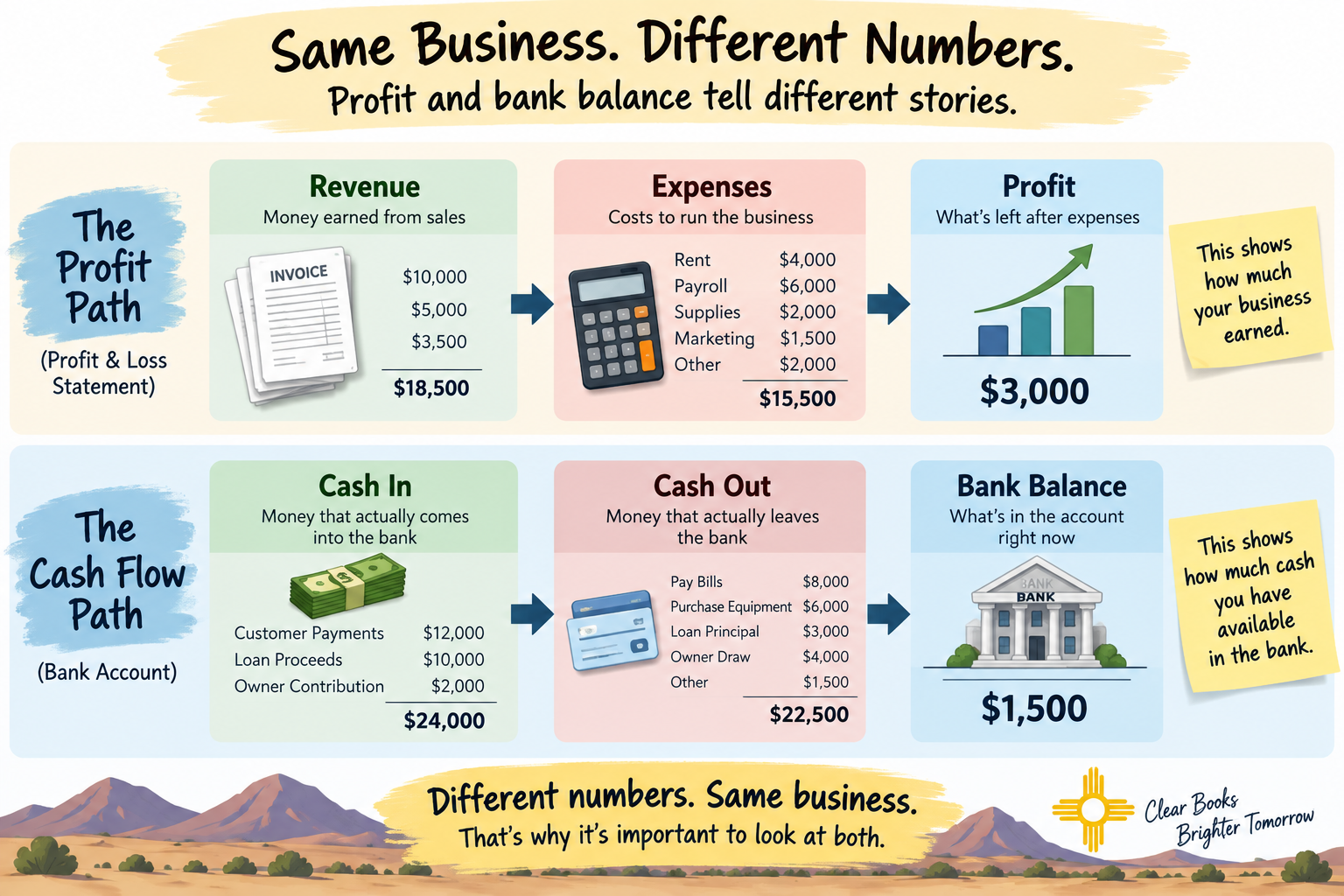
Your bank balance tells you how much cash is sitting in a particular bank account right now.
Your profit tells you how much your business earned after accounting for its income and expenses during a specific period.
They answer different questions.
Your bank balance answers:
“How much cash do I have available in this account?”
Your Profit & Loss statement answers:
“Did my business earn more than it spent during this period?”
Both numbers matter. But they aren’t interchangeable. And that’s where things can get interesting.
How You Can Have Cash Without Having Profit
Suppose your business checking account has $50,000 in it. That sounds healthy. But what if $20,000 came from a business loan? That money increased your bank balance, but taking out a loan isn’t the same thing as earning $20,000 in profit.
Or maybe you recently transferred $10,000 of your own money into the business. Again, your bank balance went up. Your business didn’t suddenly become $10,000 more profitable.
Cash can enter your bank account for reasons that aren’t business income. That’s why checking your bank balance alone can’t tell you whether the business is actually profitable.
How You Can Be Profitable Without Seeing All That Money in the Bank
The opposite can happen, too.
Your Profit & Loss statement may show a healthy profit, yet your bank account seems determined not to cooperate.
Where did the money go?
There are several possibilities.
Customers Haven’t Paid You Yet
Depending on how your books are maintained, your financial reports may show revenue from sales even though some customers haven’t paid their invoices yet.
You earned the revenue.
You just don’t have all the cash yet.
This is one reason accounts receivable deserves attention. Sales are nice. Getting paid is also rather important.
You Used Cash to Pay Down Debt
Paying down the principal on a business loan reduces your cash, but the principal portion of that payment isn’t generally an expense on your Profit & Loss statement.
So your bank balance can fall even though your reported profit doesn’t fall by the same amount.
You Bought Equipment or Other Assets
Suppose you spend $8,000 from your checking account on a piece of equipment.
Your cash balance drops immediately.
But accounting doesn’t necessarily treat the entire purchase as an expense on your Profit & Loss statement at that moment. Depending on the purchase and how it is accounted for, its cost may be reflected differently over time.
Again, cash moved.
Profit tells a different story.
You Took Money Out of the Business
Owners sometimes take money out of their businesses for personal use.
That reduces the amount of cash in the bank.
But an owner’s draw or distribution isn’t the same thing as an ordinary business operating expense.
If you’re looking only at your checking account, those distinctions disappear. Money came in. Money went out.
Your books tell you why.
A Simple Example
Imagine a business starts the month with $15,000 in the bank.
During the month, it:
- Collects $25,000 from customers
- Receives $10,000 from a business loan
- Pays $18,000 in operating expenses
- Pays $3,000 toward loan principal
- Has the owner withdraw $4,000
Ignoring other activity for simplicity, the bank balance at the end of the month would be:
$25,000
It would be easy to look at that account and think the business had a fantastic month.
But the $10,000 loan wasn’t profit.
The $3,000 principal payment and $4,000 owner withdrawal affected cash without necessarily appearing as ordinary expenses on the Profit & Loss statement.
Looking at the bank account by itself leaves out the story behind the transactions.
And that story is what you need to run the business.
Why Your Bank Account Can Be Misleading
Your bank account is excellent at answering one question:
How much money is in this account?
That’s useful information.
It can help you determine whether you have enough cash available to cover upcoming payments.
But your bank balance doesn’t tell you:
- How much revenue you generated
- How much you spent earning that revenue
- Whether expenses are increasing
- Whether customers owe you money
- How much you owe vendors
- Whether your business was profitable during the month
- Whether profitability is improving or declining
For that, you need your financial reports.
The Profit & Loss Statement Gives You the Profit Story
One of the most useful reports for understanding profitability is the Profit & Loss statement, often called the P&L or income statement.
At a basic level, it shows your business’s:
Revenue − Expenses = Profit or Loss
That sounds simple, but the information becomes much more useful when you start comparing periods.
Instead of asking:
“How much money is in the bank?”
you can start asking:
“Did we make a profit this month?”
“How does that compare with last month?”
“Are our expenses growing faster than our revenue?”
“Which expenses have changed?”
“Are we actually becoming more profitable as sales increase?”
Now your numbers are doing more than sitting there looking accounting-ish.
They’re helping you run the business.
Don’t Stop at the P&L
The P&L is important, but it isn’t the only report worth reviewing.
Balance Sheet
Your balance sheet provides a snapshot of what the business owns, what it owes, and the owner’s equity at a particular point in time.
It can help put that checking-account balance into context.
Having $40,000 in the bank looks different if the business also has $75,000 in liabilities.
Cash Flow Report
A cash flow report helps you understand how cash moved into and out of the business.
This can be especially useful when you find yourself asking the classic small-business question:
“If we’re making money, where is all the cash going?”
That’s a question worth answering.
Why Current Bookkeeping Matters
Financial reports are only useful when the information behind them is reasonably current and accurate.
If transactions haven’t been entered, accounts haven’t been reconciled, or expenses have been categorized incorrectly, your reports may not give you the picture you think they do.
Imagine trying to make a business decision using a map that’s three months out of date.
You may eventually reach your destination.
Or you may end up somewhere interesting.
Keeping your bookkeeping current gives you a much better chance of understanding what’s happening while you still have time to do something about it.
A Better Financial Habit for Business Owners
Checking your bank account isn’t a bad habit.
Using it as your only financial report is.
Instead, get into the habit of reviewing several pieces of information together.
Start with:
- Your bank balance to understand available cash.
- Your Profit & Loss statement to understand revenue, expenses, and profitability.
- Your balance sheet to understand what the business owns and owes.
- Your cash flow information to understand where cash is coming from and where it’s going.
Then compare those numbers over time.
One month tells you something.
Several months can start showing you a pattern.
Questions to Ask When Reviewing Your Numbers
You don’t need to become an accountant to get more value from your financial reports.
Start by asking practical questions:
- Is the business profitable?
- Is profit increasing or decreasing?
- Are expenses rising?
- Do we have enough cash for upcoming obligations?
- Are customers taking too long to pay?
- Are there unusual transactions that need attention?
- Does the bank balance make sense compared with what the financial reports are showing?
If you can’t answer those questions because your bookkeeping is several months behind, that’s useful information too.
It tells you where to start.
When to Get Help
If you’re running your business by checking your bank balance every morning, you’re certainly not alone.
It’s fast. It’s easy. And the number is right there on your phone.
But it isn’t the whole financial picture.
If your Profit & Loss statement doesn’t make sense, your bank accounts aren’t reconciled, or you’re not confident that your financial reports are accurate, it may be time for another set of eyes on your books.
Zia Bookkeepers Group provides bookkeeping and financial reporting services designed to help business owners maintain accurate records and better understand what’s happening in their businesses.
Your Bank Balance Is One Number. Your Business Has a Bigger Story.
Money in the bank matters.
So does profit.
So do cash flow, expenses, receivables, liabilities, and the dozens of other transactions happening behind the scenes.
The goal isn’t to pick one magic number.
It’s to understand how the numbers work together.
When your bookkeeping is current and your financial reports are accurate, you can move beyond asking, “How much money is in the bank?”
You can start asking the more useful question:
“What are my numbers telling me about my business?”
Want help understanding what your numbers are actually telling you? Schedule a free consultation with Zia Bookkeepers Group to discuss your bookkeeping needs.