
Customers keep buying. Bills keep arriving. Your bank account keeps shrinking. Something isn’t adding up.

What Is Cash Flow and Why Does It Matter to Your Business?
Your business made a profit last month. So why is there barely enough money to pay the bills? The answer might be hiding in your cash flow.

What Is Bookkeeping? A Small Business Owner’s Guide
Not long ago, I worked for a business where we used QuickBooks every day. Quotes went out. Invoices went out. Customers paid us. You might assume that meant the bookkeeping was being done. It wasn’t. The owner controlled the company’s money, but the financial records weren’t being consistently maintained. Bills would come in, and he would sometimes be surprised that there wasn’t enough money available to pay them. Some vendors got paid while others waited. Occasionally, a bill would sit for months until a supplier threatened to cut off the account. Then came the scramble. Which bills absolutely had to be paid? How much money was really available? What was still owed? What could wait? Nobody else in the business had a clear picture because the books couldn’t provide one. Tax time was even worse. The owner’s assistant, who didn’t have bookkeeping or accounting training, would try to go back through months of transactions and categorize expenses. The accountant preparing the tax return would sometimes send the records back because information was missing or transactions hadn’t been properly categorized. It was an annual attempt to reconstruct what had happened months earlier. That’s one reason I look at bookkeeping differently. Bookkeeping isn’t something you do simply because your accountant needs numbers at tax time. Done properly, it gives you financial information you can use while you’re actually running the business. Bookkeeping Is More Than Recording Transactions At its most basic, bookkeeping is the process of maintaining organized records of a business’s financial activity. That includes recording and categorizing transactions, tracking income and expenses, reconciling accounts, keeping track of money customers owe you and bills you owe vendors, and producing financial reports. The individual tasks aren’t particularly glamorous. Nobody is putting “reconciled the checking account” on a company T-shirt. But together, those tasks answer much more useful questions: How much did the business earn? Where did the money go? What bills are coming due? Which customers still owe us money? Are our records consistent with what’s actually in the bank? Did we make a profit? Those are questions you want answered before there’s a problem. What Happens When Nobody Is Really Keeping the Books? The business I described earlier wasn’t ignoring money completely. Invoices were being created. Bills were arriving. Payments were being made. Bank balances could be checked. There was plenty of financial activity. What was missing was an organized system connecting all of it. That’s an important distinction because accounting software can give the appearance that everything is being handled. You can create an invoice in QuickBooks without maintaining accurate books. You can download bank transactions without reviewing and properly categorizing them. You can look at your checking-account balance every morning and still have an incomplete picture of your company’s financial condition. In that business, the lack of bookkeeping created two recurring problems. The first was poor visibility during the year. The owner frequently had to react to bills instead of having reliable information to help plan for them. The second was tax-time cleanup. Instead of maintaining the records as transactions occurred, someone had to reconstruct months of activity long after the details were fresh. Both problems came from the same place: financial activity was happening, but the financial records weren’t keeping up with it. What Does Bookkeeping Actually Track? A good bookkeeping system creates structure around the money moving through your business. That generally includes several interconnected areas. Income and sales. You need a record of the money your business earns and where that revenue comes from. Expenses. Purchases need to be recorded and categorized so you can see what the business is actually spending money on. Bank and credit card activity. Your bookkeeping records should be regularly reconciled against financial institution statements. Reconciliation helps identify missing, duplicated, or incorrectly recorded transactions. Accounts receivable. Sending an invoice isn’t the same as collecting it. Your records should show which customers owe money and which invoices remain outstanding. Accounts payable. Bills aren’t simply expenses sitting in an inbox. They represent money your business may need to pay soon. Financial reports. Once the underlying records are maintained properly, reports such as a Profit & Loss statement and Balance Sheet turn all those individual transactions into something you can actually use. The transaction itself is only the raw material. The real value comes from turning hundreds or thousands of individual transactions into an understandable financial picture. Why Does a Small Business Need Bookkeeping? Know Where Your Money Is Going A bank statement tells you money left the account. Bookkeeping helps tell you why. Suppose you notice that expenses jumped considerably this month. Without organized records, you may have to dig through bank transactions trying to remember what happened. With properly categorized books, you can start investigating. Maybe materials increased. Maybe you purchased equipment. Maybe insurance was renewed. Maybe subcontractor costs climbed. Maybe several annual expenses happened to land in the same month. Those explanations mean very different things for the business. Good records give you somewhere to start. Understand Whether You’re Actually Making Money One of the easiest traps for a business owner is using the bank balance as a scoreboard. There’s $30,000 in checking, so things must be going pretty well. Maybe. But some of that cash might already be needed for payroll, vendor bills, loan payments, taxes, or other upcoming obligations. Meanwhile, the business could have unpaid customer invoices or expenses that don’t become obvious from looking at today’s bank balance. Your bank balance tells you how much cash is in an account at a particular moment. It does not, by itself, tell you whether your business is profitable. That’s why financial reports matter. A Profit & Loss statement, for example, organizes revenue and expenses over a period so you can evaluate the financial results of the business rather than relying on whatever number happens to appear in your checking account today. See also: “Your Bank Balance Is Not Your Profit: Here’s Why” Keep Bills and Receivables From Becoming Surprises
Your Bank Balance Is Not Your Profit: Here’s Why
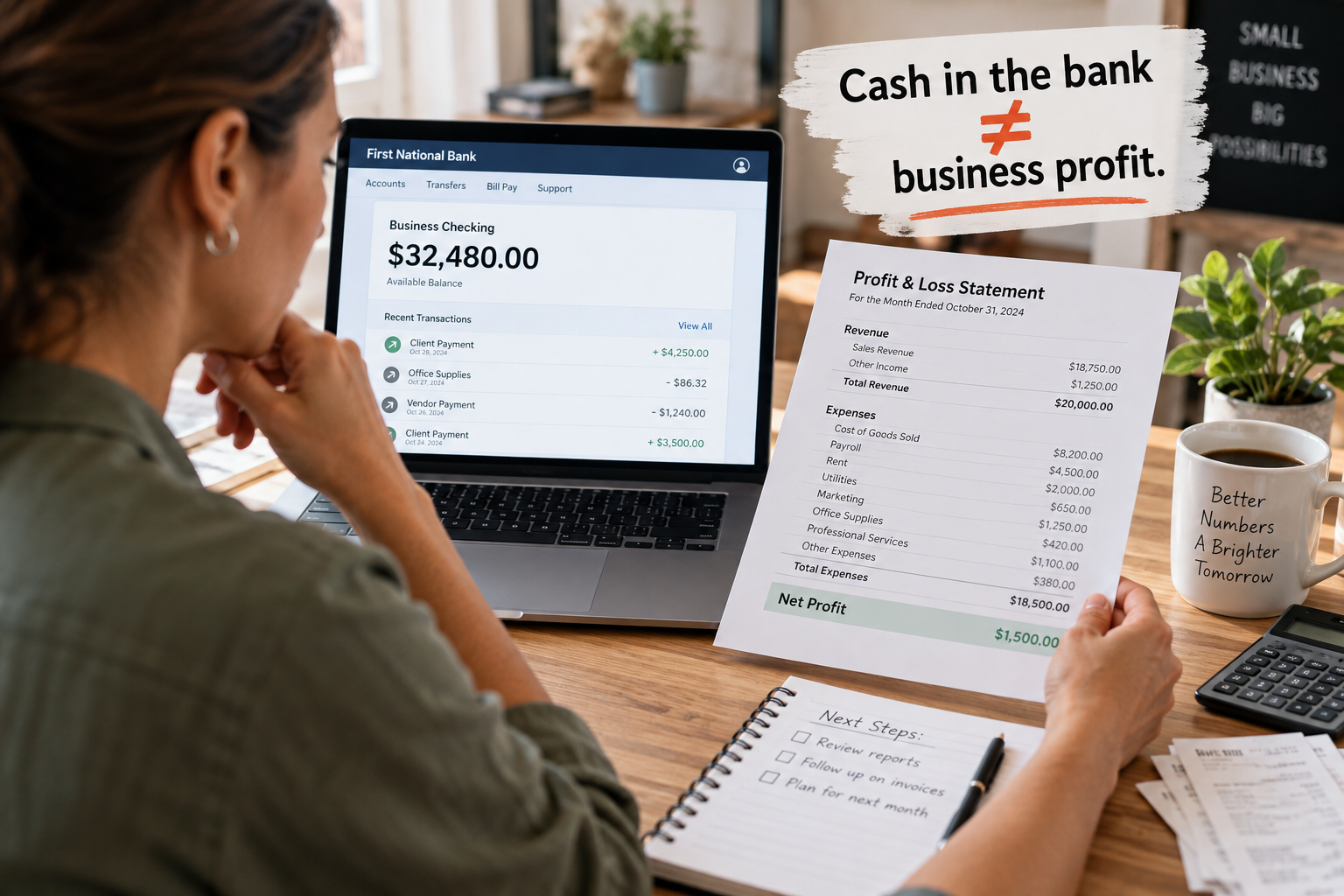
You open your banking app and see $32,000 sitting in your business checking account. Not bad. In fact, you might be tempted to think, “We made $32,000.” Then you open your Profit & Loss statement and discover that your profit is nowhere near $32,000. So which number is wrong? Probably neither. Your bank balance and your profit measure two different things, and confusing the two can give you a very misleading picture of how your business is actually doing. Bank Balance vs. Profit: What’s the Difference? Here’s the simplest way to think about it: Your bank balance tells you how much cash is sitting in a particular bank account right now. Your profit tells you how much your business earned after accounting for its income and expenses during a specific period. They answer different questions. Your bank balance answers: “How much cash do I have available in this account?” Your Profit & Loss statement answers: “Did my business earn more than it spent during this period?” Both numbers matter. But they aren’t interchangeable. And that’s where things can get interesting. How You Can Have Cash Without Having Profit Suppose your business checking account has $50,000 in it. That sounds healthy. But what if $20,000 came from a business loan? That money increased your bank balance, but taking out a loan isn’t the same thing as earning $20,000 in profit. Or maybe you recently transferred $10,000 of your own money into the business. Again, your bank balance went up. Your business didn’t suddenly become $10,000 more profitable. Cash can enter your bank account for reasons that aren’t business income. That’s why checking your bank balance alone can’t tell you whether the business is actually profitable. How You Can Be Profitable Without Seeing All That Money in the Bank The opposite can happen, too. Your Profit & Loss statement may show a healthy profit, yet your bank account seems determined not to cooperate. Where did the money go? There are several possibilities. Customers Haven’t Paid You Yet Depending on how your books are maintained, your financial reports may show revenue from sales even though some customers haven’t paid their invoices yet. You earned the revenue. You just don’t have all the cash yet. This is one reason accounts receivable deserves attention. Sales are nice. Getting paid is also rather important. You Used Cash to Pay Down Debt Paying down the principal on a business loan reduces your cash, but the principal portion of that payment isn’t generally an expense on your Profit & Loss statement. So your bank balance can fall even though your reported profit doesn’t fall by the same amount. You Bought Equipment or Other Assets Suppose you spend $8,000 from your checking account on a piece of equipment. Your cash balance drops immediately. But accounting doesn’t necessarily treat the entire purchase as an expense on your Profit & Loss statement at that moment. Depending on the purchase and how it is accounted for, its cost may be reflected differently over time. Again, cash moved. Profit tells a different story. You Took Money Out of the Business Owners sometimes take money out of their businesses for personal use. That reduces the amount of cash in the bank. But an owner’s draw or distribution isn’t the same thing as an ordinary business operating expense. If you’re looking only at your checking account, those distinctions disappear. Money came in. Money went out. Your books tell you why. A Simple Example Imagine a business starts the month with $15,000 in the bank. During the month, it: Collects $25,000 from customers Receives $10,000 from a business loan Pays $18,000 in operating expenses Pays $3,000 toward loan principal Has the owner withdraw $4,000 Ignoring other activity for simplicity, the bank balance at the end of the month would be: $25,000 It would be easy to look at that account and think the business had a fantastic month. But the $10,000 loan wasn’t profit. The $3,000 principal payment and $4,000 owner withdrawal affected cash without necessarily appearing as ordinary expenses on the Profit & Loss statement. Looking at the bank account by itself leaves out the story behind the transactions. And that story is what you need to run the business. Why Your Bank Account Can Be Misleading Your bank account is excellent at answering one question: How much money is in this account? That’s useful information. It can help you determine whether you have enough cash available to cover upcoming payments. But your bank balance doesn’t tell you: How much revenue you generated How much you spent earning that revenue Whether expenses are increasing Whether customers owe you money How much you owe vendors Whether your business was profitable during the month Whether profitability is improving or declining For that, you need your financial reports. The Profit & Loss Statement Gives You the Profit Story One of the most useful reports for understanding profitability is the Profit & Loss statement, often called the P&L or income statement. At a basic level, it shows your business’s: Revenue − Expenses = Profit or Loss That sounds simple, but the information becomes much more useful when you start comparing periods. Instead of asking: “How much money is in the bank?” you can start asking: “Did we make a profit this month?” “How does that compare with last month?” “Are our expenses growing faster than our revenue?” “Which expenses have changed?” “Are we actually becoming more profitable as sales increase?” Now your numbers are doing more than sitting there looking accounting-ish. They’re helping you run the business. Don’t Stop at the P&L The P&L is important, but it isn’t the only report worth reviewing. Balance Sheet Your balance sheet provides a snapshot of what the business owns, what it owes, and the owner’s equity at a particular point in time. It can help put that checking-account balance into context. Having $40,000 in the bank looks different if the business also has $75,000 in liabilities. Cash Flow Report A cash flow report helps you
Quarterly Estimated Taxes: What Small Business Owners Need to Know
You made money. Great. Then someone mentions quarterly estimated taxes, and suddenly part of that money doesn’t feel quite as available as it did five minutes ago. For many small-business owners, taxes work differently than they did when they received a regular paycheck. There may not be an employer withholding federal income tax throughout the year and quietly sending it to the IRS on your behalf. That doesn’t necessarily mean you get to wait until April to pay everything. Depending on your situation, you may need to make estimated tax payments during the year. The good news is that the basic idea isn’t terribly complicated. The bigger challenge is figuring out how much your business is actually earning so you and your tax professional have reliable numbers to work with. And that starts with your books. What Are Quarterly Estimated Taxes? Estimated taxes are periodic payments made toward taxes you expect to owe for the year. They’re commonly associated with self-employed people and small-business owners because business income often doesn’t have taxes automatically withheld from it. Think about the difference between an employee and a self-employed business owner. An employee might earn $5,000 in gross wages but receive considerably less in the bank because federal income tax, Social Security, Medicare, and possibly state taxes have already been withheld. A business owner can receive a $5,000 customer payment and see the entire $5,000 land in the business bank account. That doesn’t mean all $5,000 is theirs to spend. Some of it may eventually be needed for taxes. Estimated payments are one way the tax system collects those taxes during the year instead of receiving the entire amount when the annual tax return is filed. Who May Need to Pay Estimated Taxes? According to IRS guidance, individuals generally may need to make estimated tax payments if they expect to owe at least $1,000 in tax after subtracting withholding and refundable credits. That can include people operating businesses as sole proprietors as well as partners and S corporation shareholders who expect to owe tax personally. Corporations operate under different rules and generally use a separate estimated-tax threshold. But here’s the important part: business structure is only one piece of the puzzle. Whether you need to make estimated payments can depend on several factors, including: How much taxable income you expect to have Your business structure Other income you or your household receives Taxes already being withheld elsewhere Available credits Your prior-year tax liability Changes in income during the year For example, someone running a business while also working a W-2 job may already have substantial tax withheld from a paycheck. Another owner earning the same amount from the same type of business may have no withholding at all. Same business profit. Very different tax situation. That’s one reason generic advice like “just save 25% of everything you make” isn’t a substitute for an estimate based on your actual circumstances. Why Doesn’t the IRS Just Wait Until Tax Time? Federal income taxes generally operate on a pay-as-you-go system. Employees accomplish that primarily through withholding from their paychecks. Business owners and other taxpayers who receive income without sufficient withholding may accomplish it through estimated payments. If you wait until your annual return is due to pay a significant tax liability, you could potentially face an underpayment penalty even if you pay the tax due with your return. That’s what catches some new business owners by surprise. They assume April 15 is when taxes are paid. In reality, April is largely when the previous year’s income tax return is reconciled and filed. Depending on your circumstances, some of the tax associated with that income may have been expected to be paid throughout the year. When Are Quarterly Estimated Taxes Due? Despite the name, “quarterly” doesn’t mean every three months. For individuals, estimated federal tax payments are generally associated with four payment periods, with payments typically due around: April 15 June 15 September 15 January 15 of the following year If a due date falls on a weekend or legal holiday, the deadline can shift to the next business day. Always check the current IRS calendar or your tax professional for the deadlines that apply to the specific tax year you’re working with. And remember that federal estimated taxes aren’t necessarily the whole story. State tax requirements may also apply. How Much Should You Pay? This is where bookkeeping walks onto the stage carrying a very important clipboard. Your estimated tax calculation depends, in part, on knowing how much money the business is actually making. And that is not the same thing as looking at your bank balance. Suppose your business has collected $80,000 so far this year. That doesn’t necessarily mean you have $80,000 of taxable business profit. Maybe you also had $45,000 of legitimate business expenses. Your bookkeeping might therefore show something closer to: Revenue: $80,000Expenses: $45,000Net profit: $35,000 Those are very different numbers. Your tax professional needs reliable financial information to help determine how that business activity affects your tax situation. If your books show $35,000 in profit when the real number is $55,000 because expenses were duplicated, that’s a problem. If the books show $55,000 when the real number is $35,000 because legitimate expenses haven’t been recorded, that’s a problem too. Your tax estimate is only as useful as the information feeding it. What Are the Estimated-Tax Safe Harbor Rules? The IRS has rules that can help taxpayers determine whether enough tax has been paid during the year to avoid an estimated-tax underpayment penalty. For many individual taxpayers, the general federal rule is based on paying at least: 90% of the tax for the current year, or 100% of the tax shown on the previous year’s return, whichever applicable test provides the required payment level. A higher prior-year percentage generally applies to certain higher-income taxpayers. There are also special rules and exceptions for certain taxpayers and circumstances. This is an area where your tax professional should be involved. Your bookkeeper can help