

Not long ago, I worked for a business where we used QuickBooks every day. Quotes went out. Invoices went out. Customers paid us.
You might assume that meant the bookkeeping was being done.
It wasn’t.
The owner controlled the company’s money, but the financial records weren’t being consistently maintained. Bills would come in, and he would sometimes be surprised that there wasn’t enough money available to pay them. Some vendors got paid while others waited. Occasionally, a bill would sit for months until a supplier threatened to cut off the account.
Then came the scramble.
Which bills absolutely had to be paid? How much money was really available? What was still owed? What could wait?
Nobody else in the business had a clear picture because the books couldn’t provide one.
Tax time was even worse. The owner’s assistant, who didn’t have bookkeeping or accounting training, would try to go back through months of transactions and categorize expenses. The accountant preparing the tax return would sometimes send the records back because information was missing or transactions hadn’t been properly categorized.
It was an annual attempt to reconstruct what had happened months earlier.
That’s one reason I look at bookkeeping differently.
Bookkeeping isn’t something you do simply because your accountant needs numbers at tax time. Done properly, it gives you financial information you can use while you’re actually running the business.
Bookkeeping Is More Than Recording Transactions
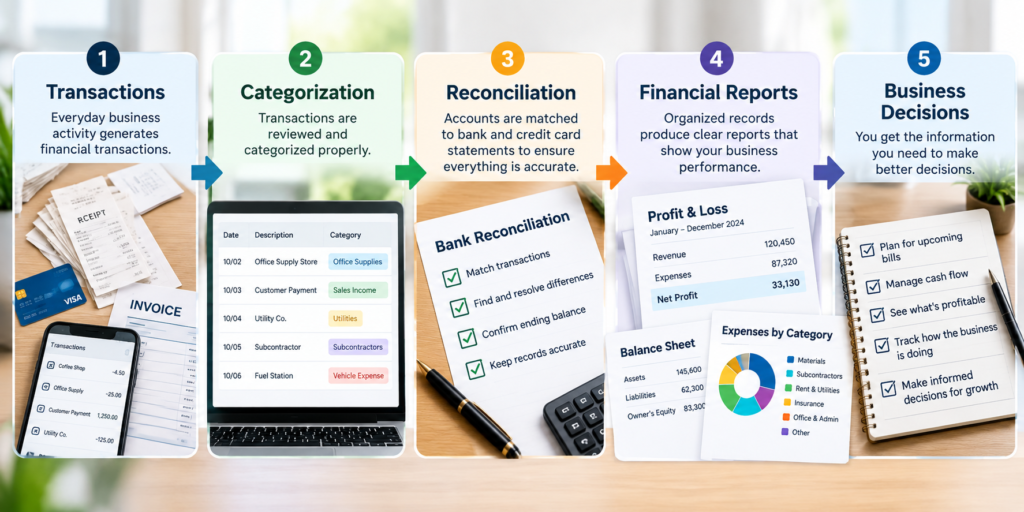
At its most basic, bookkeeping is the process of maintaining organized records of a business’s financial activity.
That includes recording and categorizing transactions, tracking income and expenses, reconciling accounts, keeping track of money customers owe you and bills you owe vendors, and producing financial reports.
The individual tasks aren’t particularly glamorous. Nobody is putting “reconciled the checking account” on a company T-shirt.
But together, those tasks answer much more useful questions:
How much did the business earn?
Where did the money go?
What bills are coming due?
Which customers still owe us money?
Are our records consistent with what’s actually in the bank?
Did we make a profit?
Those are questions you want answered before there’s a problem.
What Happens When Nobody Is Really Keeping the Books?
The business I described earlier wasn’t ignoring money completely.
Invoices were being created. Bills were arriving. Payments were being made. Bank balances could be checked.
There was plenty of financial activity.
What was missing was an organized system connecting all of it.
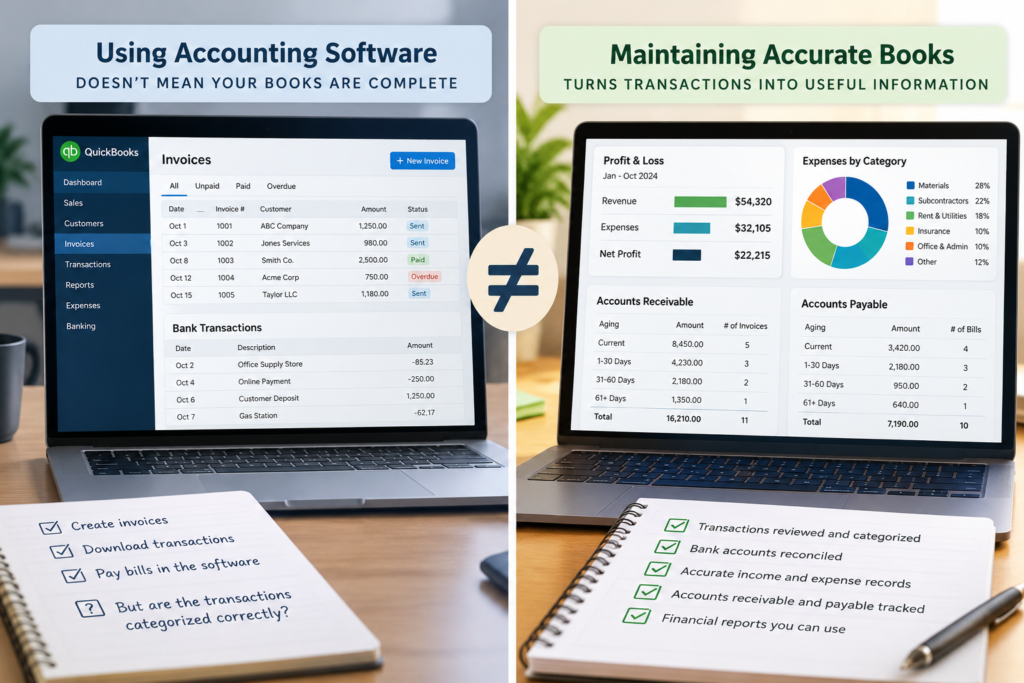
That’s an important distinction because accounting software can give the appearance that everything is being handled. You can create an invoice in QuickBooks without maintaining accurate books. You can download bank transactions without reviewing and properly categorizing them. You can look at your checking-account balance every morning and still have an incomplete picture of your company’s financial condition.
In that business, the lack of bookkeeping created two recurring problems.
The first was poor visibility during the year. The owner frequently had to react to bills instead of having reliable information to help plan for them.
The second was tax-time cleanup. Instead of maintaining the records as transactions occurred, someone had to reconstruct months of activity long after the details were fresh.
Both problems came from the same place: financial activity was happening, but the financial records weren’t keeping up with it.
What Does Bookkeeping Actually Track?
A good bookkeeping system creates structure around the money moving through your business.
That generally includes several interconnected areas.
Income and sales. You need a record of the money your business earns and where that revenue comes from.
Expenses. Purchases need to be recorded and categorized so you can see what the business is actually spending money on.
Bank and credit card activity. Your bookkeeping records should be regularly reconciled against financial institution statements. Reconciliation helps identify missing, duplicated, or incorrectly recorded transactions.
Accounts receivable. Sending an invoice isn’t the same as collecting it. Your records should show which customers owe money and which invoices remain outstanding.
Accounts payable. Bills aren’t simply expenses sitting in an inbox. They represent money your business may need to pay soon.
Financial reports. Once the underlying records are maintained properly, reports such as a Profit & Loss statement and Balance Sheet turn all those individual transactions into something you can actually use.
The transaction itself is only the raw material. The real value comes from turning hundreds or thousands of individual transactions into an understandable financial picture.
Why Does a Small Business Need Bookkeeping?
Know Where Your Money Is Going
A bank statement tells you money left the account.
Bookkeeping helps tell you why.
Suppose you notice that expenses jumped considerably this month. Without organized records, you may have to dig through bank transactions trying to remember what happened.
With properly categorized books, you can start investigating.
Maybe materials increased. Maybe you purchased equipment. Maybe insurance was renewed. Maybe subcontractor costs climbed. Maybe several annual expenses happened to land in the same month.
Those explanations mean very different things for the business.
Good records give you somewhere to start.
Understand Whether You're Actually Making Money
One of the easiest traps for a business owner is using the bank balance as a scoreboard.
There’s $30,000 in checking, so things must be going pretty well.
Maybe.
But some of that cash might already be needed for payroll, vendor bills, loan payments, taxes, or other upcoming obligations. Meanwhile, the business could have unpaid customer invoices or expenses that don’t become obvious from looking at today’s bank balance.
Your bank balance tells you how much cash is in an account at a particular moment.
It does not, by itself, tell you whether your business is profitable.
That’s why financial reports matter. A Profit & Loss statement, for example, organizes revenue and expenses over a period so you can evaluate the financial results of the business rather than relying on whatever number happens to appear in your checking account today.
See also: “Your Bank Balance Is Not Your Profit: Here’s Why”
Keep Bills and Receivables From Becoming Surprises
Money owed to you and money you owe other people can quietly create problems when they’re not being tracked.
Imagine that you invoiced $15,000 this month.
That sounds great.
But what if $8,000 hasn’t been collected?
Now imagine that several vendor bills are due next week.
Suddenly, the sales number doesn’t tell you nearly enough.
Maintaining accounts receivable and accounts payable gives you better visibility into both sides of that equation: money you’re expecting and obligations that are approaching.
That doesn’t magically solve a cash-flow problem. It does make the problem much harder to hide.
Make Tax Time Less Chaotic
Bookkeeping and tax preparation aren’t the same job, but they are closely connected.
Your tax professional needs reliable financial information.
If transactions haven’t been properly recorded or categorized throughout the year, someone may eventually have to reconstruct that information. That can mean searching through bank statements, credit card transactions, receipts, invoices, and old emails trying to answer questions about purchases made months ago.
“What was this $683 charge from last February?”
Not exactly the ideal tax-season scavenger hunt.
Keeping the books current throughout the year gives your tax professional more organized records to work from and gives you a better chance of answering questions while you still remember what actually happened.
See also: Quarterly Estimated Taxes: What Small Business Owners Need to Know
Make Decisions With Better Information
This may be the most overlooked reason for keeping accurate books.
Business owners make financial decisions constantly.
Can we afford another employee?
Are expenses increasing faster than revenue?
Which customers still owe us money?
Do we have enough cash available for an upcoming purchase?
Why was profit lower this quarter?
Are we spending significantly more in a particular category?
Bookkeeping won’t make those decisions for you.
It gives you better information to make them.
That’s a much more useful role than simply storing transactions until somebody needs them for a tax return.
Doesn't Accounting Software Do the Bookkeeping for Me?
Can I Do My Own Bookkeeping?
Absolutely. Many small-business owners do.
The better question is whether you can keep up with it accurately and consistently while running everything else.
DIY bookkeeping tends to become a problem when transactions start piling up, accounts aren’t being reconciled, you’re unsure how to categorize transactions, reports don’t make sense, or bookkeeping gets postponed until there’s an immediate reason to deal with it.
If you’re doing your own bookkeeping, establish a regular routine rather than treating it as an emergency project.
Review transactions. Reconcile your accounts. Check unpaid invoices and upcoming bills. Review your financial reports. Investigate numbers that don’t make sense.
If you don’t understand something, don’t simply force the numbers to work and move on. That’s how small bookkeeping problems acquire roommates.
How Often Should Bookkeeping Be Done?
Bookkeeping should be maintained regularly enough that the information remains useful.
Waiting until the end of the year defeats much of the purpose.
Some activities may need attention more frequently than others. A business with substantial daily activity may need to review certain records throughout the week, while other bookkeeping tasks may be handled on a weekly or monthly schedule.
The exact routine depends on the business.
What’s important is consistency.
If it’s September and the last month you could confidently explain is March, your books have stopped functioning as a management tool. They’re becoming a history-reconstruction project.
Your Books Should Tell You Something Useful
That business I worked for had accounting software. It had invoices. It had bank statements. It had an accountant preparing the tax return.
What it didn’t have was reliable bookkeeping tying everything together.
The result was predictable: uncertainty about available money, overdue bills, supplier problems, tax-time scrambling, and financial decisions being made without a clear picture of the company’s records.
Those problems weren’t caused by the absence of financial information.
The information existed.
It simply wasn’t being organized into something the owner could use.
That’s what bookkeeping is supposed to do.
Your books should help you understand what’s happening in your business while you still have time to do something about it.
Want a clearer picture of your books?
If you’re not sure whether your bookkeeping is current, accurate, or giving you useful information, Zia Bookkeepers Group offers a free bookkeeping audit to give your records a second set of eyes.
Or, if you’re ready to discuss getting help with your bookkeeping, you can schedule a free consultation to talk about your needs and receive a quote.
You don’t need to wait until tax time, a cash crunch, or a supplier phone call makes the decision for you.