

I learned this lesson the hard way, back when I was helping a client (a small marketing agency, ten people, great work, terrible cash habits) figure out why payroll felt like a monthly heart attack. Every two weeks, the owner would call me in a slight panic, asking if we were “okay.” We were always technically okay. But “technically okay” is not a financial strategy. It’s a coping mechanism.
That’s when I built my first real 90-day cash plan for a client, mostly out of self-defense. I was tired of the panicked calls. And once I saw how much stress it removed, just from knowing what was coming, I started building this same plan for basically every business I work with.
So let me save you a few years of trial and error. Here’s how to build one that actually works.
Why 90 days is the sweet spot
I tried the one-week version first. Big mistake. You don’t see problems coming until they’re already banging on the door. Then I tried a 12-month version, the classic finance-nerd move. Also a mistake, because half the assumptions were wrong by month three, and nobody updated it after that. It just sat in a folder, judging me.
Ninety days is the range that actually works in real life. It’s long enough to catch a slow month before it becomes an emergency, and short enough that you’ll actually keep it updated instead of abandoning it like a gym membership.
Step 1: Map your incoming cash (not your revenue)
This is the mistake I see most often, and I made it myself early in my career. I used to look at invoiced revenue and think “great, we’re covered.” Except invoiced isn’t paid, and I learned that the hard way when a client sat on a $30,000 invoice for six weeks while I’d already mentally spent that money on covering payroll.
Now, for every client I work with, we split incoming cash into three buckets for each of the next 12 weeks:
- Cash we’re confident about (signed contracts, recurring clients, the customer who pays like clockwork)
- Cash that’s likely but not locked in (invoices sent, waiting on payment)
- Cash that’s a maybe (deals still being discussed)
And here’s the part I had to learn through a few uncomfortable months: only count the “maybe” money at a discount. If there’s a 50% chance a deal closes, plan as if half the cash shows up. I used to plan on hope. Hope doesn’t cover payroll.
Step 2: List every bill, not just the scary ones
Rent and payroll get all the attention because they’re loud. But I recently had a client get blindsided by an annual insurance renewal that landed the same week as a slow month. Nobody remembered it was coming because it only showed up once a year, quietly, like a raccoon that only raids your trash cans in October.
Now I always tell people: pull your bank and credit card statements from the last 90 days and write down every single recurring cost. Then add anything with a due date in the next 90 days, even annual stuff. If it’s due in October, it goes in the plan today, not in September when you suddenly remember it exists.
Step 3: Nail down payroll, because people notice when they don't get paid
I’ve sat across the desk from an owner trying to explain to me why payroll might be a few days late. I never want to be in that meeting again, and I definitely don’t want you in it either.
Map every payroll date for the next three months with the exact amount, taxes and benefits included. If you’re planning to hire, add that cost starting on their actual start date, not the day you posted the job listing (I’ve seen that mistake cost a business a very uncomfortable month). The 90-day view is what saves you here. You’ll spot a tight payroll week a month in advance instead of two days before, which is the difference between “let’s shift some things around” and “let’s panic.”
Step 4: Be honest about owner draws
I used to feel a little weird telling clients to pay themselves consistently. It felt almost indulgent to say out loud. But I’ve watched too many owners run their business into the ground while paying everyone else on time and paying themselves last, or not at all. That’s not admirable. That’s a fast track to burnout.
Your draw should come from what’s actually left after bills and payroll clear, not from what you wish was left. I always tell clients to set a realistic number for each month based on the plan. Good month, take a bit more. Tight month, take less. The businesses I’ve watched succeed long term treat this as a flexible, planned number, not a guessing game they figure out on the 1st of the month.
Step 5: Put it all in one simple view
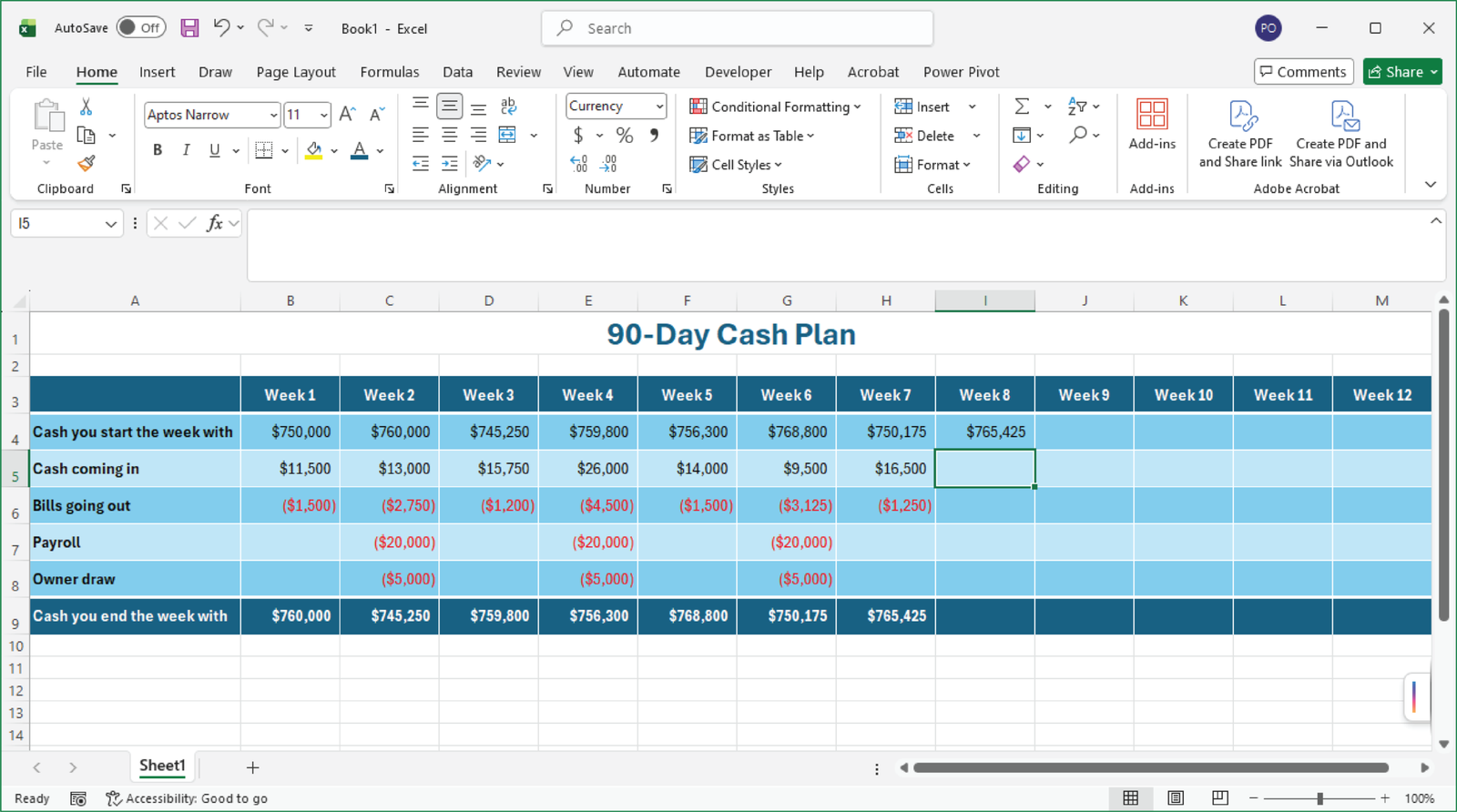
You don’t need fancy software. I’ve built these in a basic spreadsheet more times than I can count. Weeks across the top, these rows down the side:
- Cash you start the week with
- Cash coming in
- Bills going out
- Payroll
- Owner draw
- Cash you end the week with
That last row is the one I watch most closely with clients. The first time an owner sees a dip coming three weeks out instead of getting surprised by it, you can watch the stress leave their shoulders in real time. That reaction is honestly why I keep doing this work.
Step 6: Update it every week (yes, really)
I’ll admit it, I used to build these plans and let them go stale. Then reality would drift so far from the plan that it became useless, kind of like a GPS that hasn’t recalculated in an hour. You’re technically still on a road, just not the right one.
Now I block 15 minutes every week to check actual numbers against the plan. Did the client pay on time? Did a bill come in higher than expected? Adjust the rest of the 90 days right then. It’s a small habit that makes a massive difference, and it’s the number one reason the clients who stick with this feel calm about money instead of anxious.
The bottom line
A 90-day cash plan won’t stop surprises from happening. I wish I could promise that. But it will make sure you see them coming from down the road instead of getting blindsided in the parking lot, which is where I used to live before I started doing this properly. Kidding! You’ll know which months are tight, which are comfortable, and exactly how much you can pay yourself without holding your breath.
Running a business is hard enough without also playing “guess the bank balance” every Friday afternoon. Trust me, I’ve played that game. It’s not fun, and you don’t win prizes.
Start planning today!
Want help turning your reports into a plan? Ask about our monthly advisory support.
Click Here